Thinking Fast and Slow
Daniel Kahneman
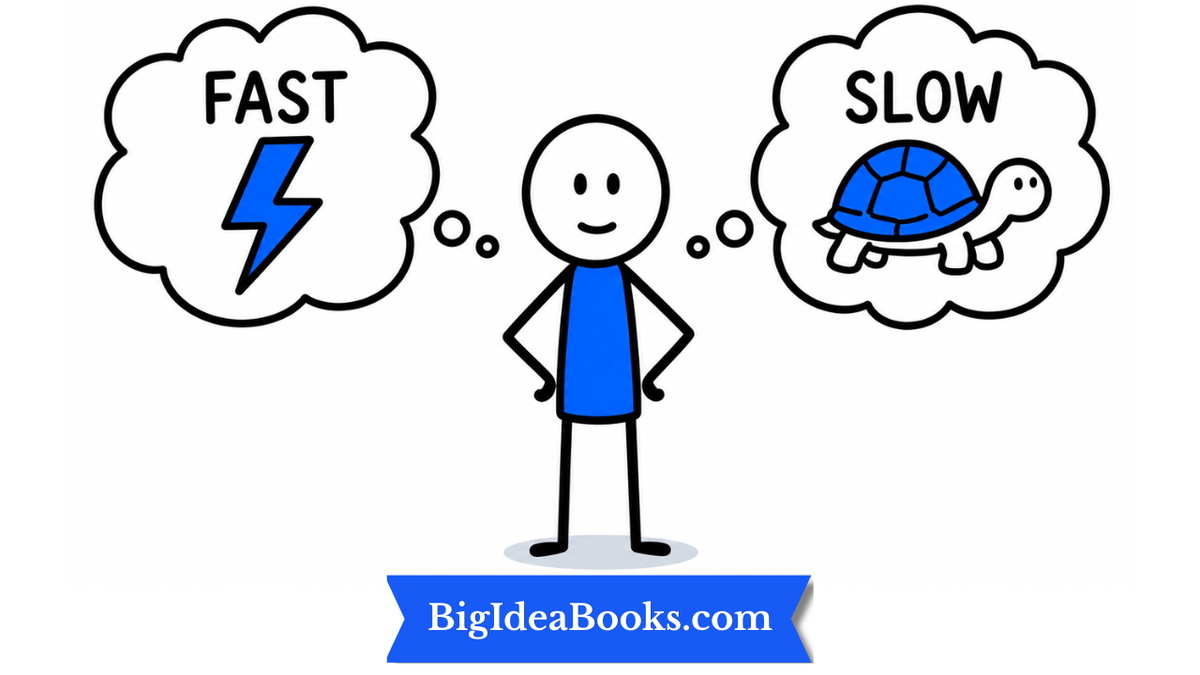
Your mind is extraordinarily good at reaching conclusions quickly. That ability helps you move through daily life without analyzing every choice from scratch, but it also creates a problem: a thought can feel obvious long before you've examined whether it's accurate. Better decisions often begin not with thinking more, but with recognizing when your first answer deserves a second look.
Know When to Slow Down Your Thinking
Your mind doesn't approach every problem with the same amount of effort. Some thoughts arrive almost instantly. Others require concentration, calculation, self-control, or deliberate attention.
These two modes can be understood as System 1 and System 2. System 1 works quickly and automatically. It's the part of your mind that reacts to an unexpected sound or produces an immediate impression without requiring conscious effort. System 2 handles more demanding mental work, such as focusing carefully, reasoning through a problem, or checking whether an answer actually makes sense.
The difficulty is that System 1 doesn't always wait for System 2 when it should. Consider a simple problem: a bat and a ball together cost $1.10, and the bat costs $1 more than the ball. The immediate answer that often comes to mind is 10 cents. But if the ball cost 10 cents, the bat would cost $1.10, making the total $1.20. The correct answer is 5 cents.
The mistake happens because the intuitive answer feels easy and convincing. Checking it requires more effort, and the mind tends to conserve that effort whenever it believes the fast answer is good enough.
That doesn't mean fast thinking is bad. You couldn't function efficiently if every tiny decision required careful analysis. The useful skill is learning to recognize situations in which speed becomes a liability.
When the stakes are meaningful, the problem is unfamiliar, or your answer appeared suspiciously quickly, give System 2 a chance to participate. Don't automatically distrust your intuition. Simply remember that confidence and correctness aren't the same thing.
When is deliberate System 2 thinking especially useful?
Question the Story Your Mind Creates From Limited Information
Your mind doesn't like incomplete pictures. When information is missing, it often fills the gaps so smoothly that you may not notice how little evidence you actually have.
Imagine meeting someone who is friendly and easy to talk to. Later, you're asked whether that person might be generous. You don't really know. Yet the positive impression created by friendliness can spill over into your judgment of qualities you've never observed.
This is the halo effect. One favorable characteristic influences how you see the person as a whole. Confirmation bias creates a related problem: once an idea has been suggested or accepted, the mind becomes receptive to information that supports it.
Both tendencies reveal something important about judgment. Your mind can create a coherent story from surprisingly little information, and coherence feels persuasive. The story seems complete, so the conclusion seems justified.
But a good story isn't necessarily a complete picture.
This becomes especially dangerous when confidence grows faster than evidence. The mind naturally forms mental models of how the world works and then uses those models to make decisions. Even when contradictory information is available, a familiar mental picture can remain remarkably powerful.
A better habit is to separate the quality of the story from the quality of the evidence behind it. When a conclusion feels obvious, ask what you actually know. What information is missing? What assumptions have quietly been added? What evidence might change the conclusion?
The goal isn't to become suspicious of every thought. It's to stop treating a convincing explanation as proof that you've seen the whole picture.
What is the best way to protect yourself from a convincing judgment built on limited information?
Use Base Rates and Evidence Instead of Intuition
Predictions become especially difficult when a vivid detail competes with a boring statistic. The vivid detail usually feels more relevant. Unfortunately, feeling relevant and being predictive are two different things.
Suppose a taxi company operates a fleet made up of 80 percent red taxis and 20 percent yellow taxis. If you know nothing else about the next taxi that will appear, red is the more reasonable prediction because red taxis are far more common.
That underlying frequency is the base rate. Yet people often neglect base rates when some other piece of information captures their attention. Even after seeing several red taxis in a row, for example, you might begin expecting a yellow taxi because it feels as though one is "due." The basic distribution hasn't changed simply because the recent sequence caught your attention.
The same principle matters far beyond simple probability problems. Whenever you're trying to forecast an outcome, your impression of the individual situation can overshadow what usually happens in comparable situations.
One way to improve predictions is to use a reference class. Instead of starting with a detailed story about why this particular situation will be different, look at relevant examples of similar situations and ask what normally happened. Then adjust your prediction when you have genuine evidence that justifies doing so.
This approach can feel less satisfying than intuition because statistics don't create much of a story. They don't tell you why this case feels special. But that is partly the point.
When predicting what will happen next, start outside the story. Look first at the broader pattern, then move inward to the details of the current case.
What is the strongest starting point when making a prediction about an uncertain outcome?
Recognize When Losses Are Distorting Your Decisions
A gain and a loss of the same size don't necessarily feel equally powerful. Losing something often affects you more strongly than gaining the equivalent amount.
This is loss aversion, and it helps explain why decisions that look similar on paper can produce very different behavior.
Imagine receiving $1,000 and then choosing between a guaranteed additional $500 or a 50 percent chance of gaining another $1,000. Now imagine beginning with $2,000 and choosing between a guaranteed loss of $500 or a 50 percent chance of losing $1,000.
Either way, the possible final outcomes are closely related. Yet people tend to behave differently when the choice is framed as a gain versus a loss. A sure gain can seem attractive, while a sure loss can make gambling feel worth the risk.
Part of the reason is that you don't evaluate outcomes in isolation. You evaluate them relative to a reference point. Ending with $1,500 can feel like success if you started with $1,000 and like failure if you started with $2,000.
This means a decision can be influenced not only by where you may end up, but by where you mentally decided the comparison should begin.
The practical lesson is to examine the outcome separately from the feeling of gaining or losing. When a choice involves money, opportunity, status, or anything else you value, ask whether you would evaluate the options differently if your starting point changed.
You may discover that you're not simply choosing between outcomes. You're reacting to the psychological pain of moving backward from a reference point you've already accepted.
Why can two similar outcomes lead to very different decisions?
Try the Big Ideas
- Create a deliberate-thinking trigger. The next time you're making a meaningful decision and an answer feels immediately obvious, give yourself one extra check. Recalculate the numbers, reconsider the assumption, or explain why your first answer is correct before acting on it.
- Separate evidence from the story. When you form a strong opinion about a person, situation, or opportunity, write down what you actually know. Then identify anything you've assumed, inferred, or filled in yourself. The distinction can reveal how much of your confidence comes from evidence and how much comes from a coherent story.
- Start predictions with the outside view. Before deciding what you think will happen, ask what normally happens in similar cases. Use that as your starting point, then adjust only when specific evidence gives you a reason to believe the current situation is meaningfully different.
- Reframe choices involving loss. When you're reluctant to give something up or tempted to take an unusual risk to avoid a loss, compare the actual final outcomes rather than focusing only on what you're losing from your current position. Changing the reference point can make the underlying tradeoff easier to see.
Key Takeaways
Better thinking doesn't require rejecting intuition or analyzing every choice endlessly. It requires knowing where intuition is vulnerable: fast answers can escape scrutiny, incomplete evidence can become a convincing story, vivid details can overpower statistical reality, and the fear of loss can change how identical outcomes feel. Learning to recognize those moments gives deliberate thinking a chance to do what it does best—check the first impression, examine the evidence, widen the frame, and make a decision based on more than what happens to feel right.