Badass Habits
Jen Sincero
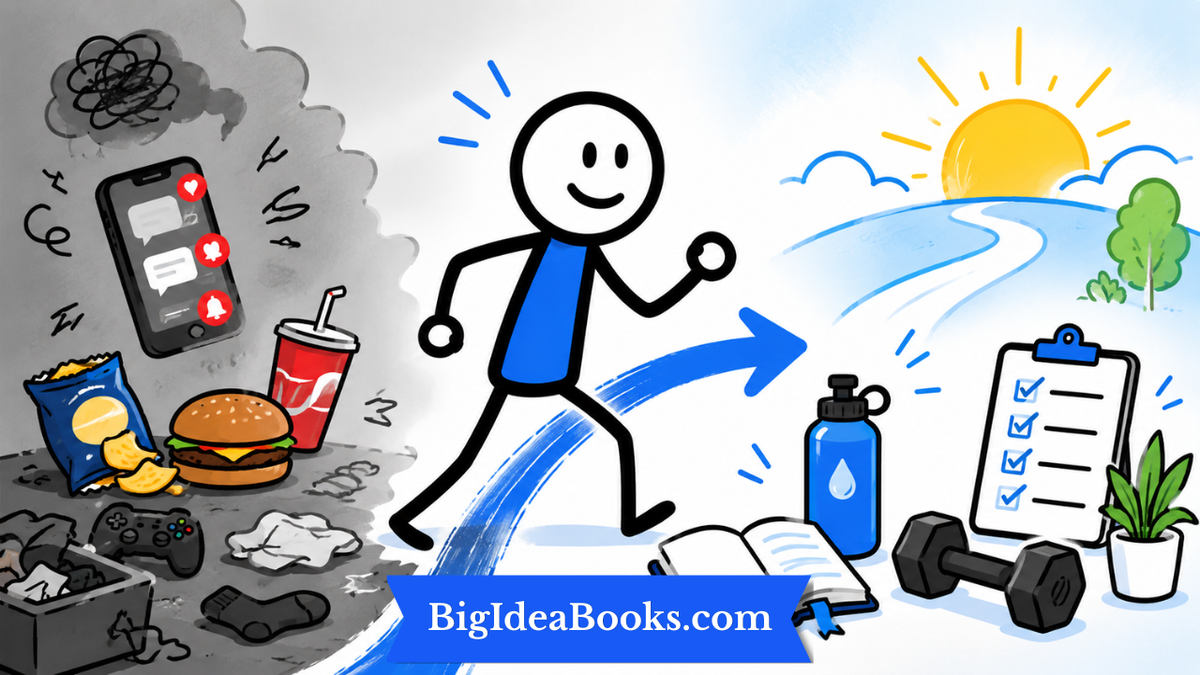
Changing your habits isn't only about becoming more disciplined. The routines that last are usually supported by something deeper: a life you genuinely want, an environment that makes good choices easier, and the ability to recover when things don't go perfectly. Habit change becomes much more sustainable when you stop treating every setback as a crisis and start building conditions that help the new behavior survive. These five ideas show how to make that shift.
Build Boundaries That Protect Your Habits
A habit doesn't exist in isolation. It has to compete with your schedule, other people's expectations, distractions, invitations, responsibilities, and whatever else happens to demand your attention.
That's why boundaries matter. If you've decided that a particular behavior is important, you need to protect enough time, energy, and attention to actually follow through. Otherwise, your intentions can disappear whenever someone else wants something from you.
Imagine you're trying to become someone who exercises every morning. That commitment becomes difficult to maintain if you regularly stay out late simply because friends ask you to, or if you allow every unexpected request to take priority over the routine you're trying to build. The problem isn't necessarily the habit itself. The problem may be that nothing around it is protected.
Boundaries require deciding what you will and won't do, what treatment you'll accept, and which outside pressures deserve your attention. They don't have to begin with dramatic confrontations. You can practice in small, low-stakes situations and gradually become more comfortable protecting the choices that matter to you.
Why can boundaries make a new habit easier to maintain?
Reinforce Progress With Small Rewards
Creating a habit can feel difficult because the long-term benefits may be far away. A healthier body, a cleaner home, stronger finances, or greater peace of mind may take time to develop. The effort, however, happens now.
Small rewards can make that gap easier to manage. When you acknowledge yourself for following through, you're giving the behavior an immediate positive association instead of asking yourself to wait indefinitely for the eventual payoff.
You might mark each successful day on a calendar, use a sticker or another visible symbol of progress, or allow yourself a simple pleasure after completing the routine. The reward doesn't need to be elaborate. It simply needs to make success noticeable.
The important part is choosing a reward that doesn't undo the behavior you're trying to strengthen. If you're building a healthier eating routine, for example, celebrating every successful day with something that directly undermines that routine defeats the purpose. A good reward supports your progress rather than competing with it.
What makes a reward useful when you're building a habit?
Treat Setbacks as Interruptions, Not Failure
Sooner or later, something will go wrong.
You'll miss the workout. Eat something you meant to avoid. Skip the routine. Stay up too late. Forget the practice you promised yourself you'd complete.
The mistake becomes far more damaging when you turn one bad moment into evidence that you've failed completely. Once that happens, abandoning the habit can feel almost logical. If the streak is already broken, why bother continuing?
A more useful response is to treat the setback for what it is: one interruption.
Acknowledge what happened, remember the progress you've already made, and return to the behavior. You don't need to erase the mistake or punish yourself for it. You simply need to prevent one deviation from becoming permission to abandon the larger change.
Consistency matters, but consistency doesn't require perfection. What matters after a mistake is the decision that comes next.
What is the most useful response after slipping up on a new habit?
Replace Bad Habits Instead of Simply Removing Them
Trying to eliminate a bad habit creates a simple problem: you're taking something away without necessarily deciding what will happen in its place.
That can leave you repeatedly focused on what you're trying not to do. Don't bite your nails. Don't reach for the snack. Don't fall into the old routine. The unwanted behavior remains at the center of your attention.
A replacement habit gives you somewhere else to direct that energy.
Instead of focusing only on stopping an unwanted behavior, introduce a new routine that makes the old one less appealing or less convenient. Someone trying to stop biting their nails, for example, might begin getting regular manicures. Caring for their nails introduces a new routine while creating another reason to avoid damaging them.
Replacement changes the task from simply resisting something to practicing something different. Rather than leaving an empty space where the old habit used to be, you begin filling that space with a behavior that's more consistent with the direction you want your life to take.
Why can replacing a bad habit be more useful than focusing only on stopping it?
Use Self-Improvement to Build a Better Life, Not a Perfect One
There's a strange risk hidden inside self-improvement: you can become so focused on improving your life that you forget to enjoy it.
Eating well matters. Exercise can matter. Sleep can matter. Productive routines can matter. But optimizing every corner of your existence isn't the point.
A life organized perfectly around good habits can still become unsatisfying if those habits crowd out relationships, hobbies, laughter, rest, or the things that make you feel like yourself. Improvement should help you participate more fully in your life, not turn life into an endless improvement project.
That also means accepting that not everything about you needs to be fixed. You can become healthier or more disciplined without rejecting the person you already are. Your quirks, imperfect moments, and occasional mistakes are part of being human.
The deeper purpose of a useful habit is to help you become a better version of yourself while still honoring the life you're trying to improve. Self-compassion belongs in that process. The goal isn't perfection. It's creating routines that support more of what genuinely matters to you.
What should ultimately guide your efforts to improve your habits?
Try the Big Ideas
- Protect one habit with a boundary. Choose one behavior you're serious about maintaining and identify the outside pressure most likely to disrupt it. Decide in advance what you'll say no to, change, or limit so that the habit has room to survive.
- Create an immediate reward for consistency. Pick a simple way to acknowledge each successful repetition of a habit, such as marking a calendar or saving a favorite activity until after you've followed through. Choose something enjoyable that doesn't work against the progress you're making.
- Decide how you'll respond to your next setback before it happens. Write one simple rule for yourself: if you miss the habit once, you'll return to it at the next reasonable opportunity. This keeps a mistake from becoming a decision to quit.
- Give an unwanted habit a replacement. Identify one behavior you'd like to stop and ask what you could deliberately do instead when the usual moment arrives. Choose a replacement that's realistic enough to use repeatedly, rather than depending entirely on resistance.
- Leave something imperfect on purpose. Look at the habits you're trying to improve and ask whether you're working toward a better life or simply trying to optimize yourself. Keep the routines that genuinely support your health, happiness, relationships, or goals, while giving yourself permission to remain human.
Key Takeaways
Strong habits aren't built by demanding flawless behavior from yourself. They're supported by boundaries that protect what matters, rewards that make progress visible, resilience that helps you return after setbacks, and replacement behaviors that give unwanted routines somewhere productive to go. Most importantly, habit change should serve your life rather than consume it. The goal isn't to become perfectly optimized; it's to create patterns that make it easier to live as a healthier, happier, and more authentic version of yourself.