Atomic Habits
James Clear
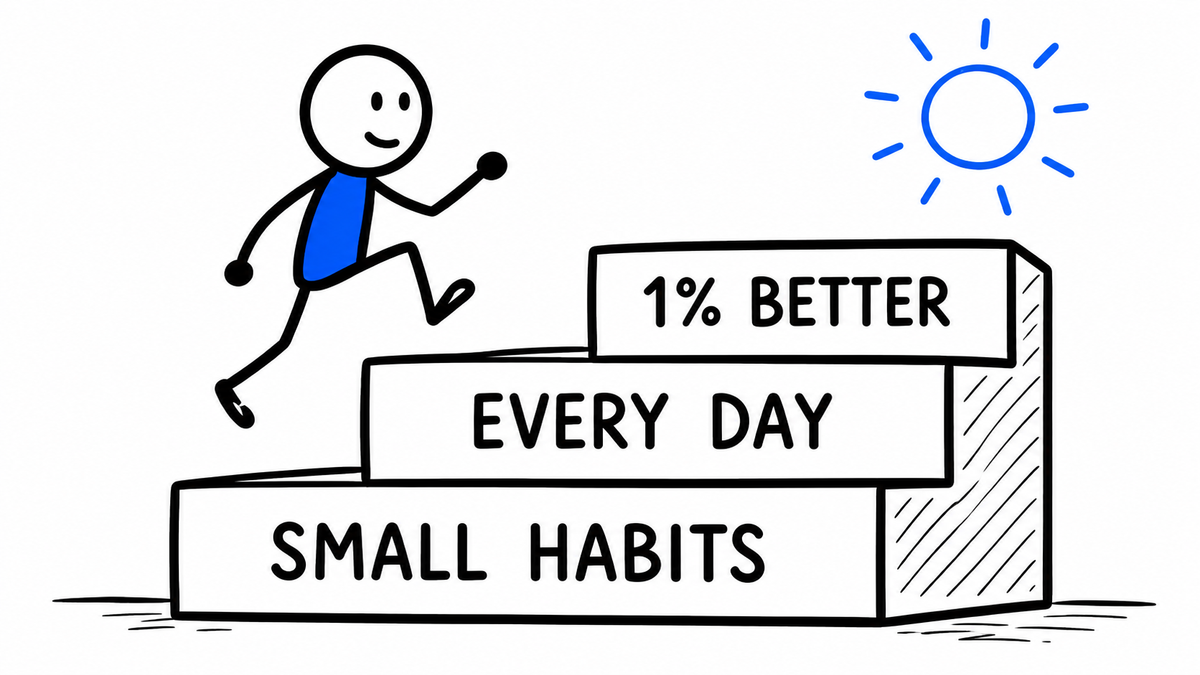
Big changes rarely look big at the beginning. A behavior repeated once may seem almost meaningless, yet the same behavior repeated for months or years can send your life in a completely different direction. The challenge is building habits that survive long enough for those delayed results to appear. That becomes much easier when you stop depending on willpower and start shaping the conditions that make good behavior easier to begin and repeat.
Let Small Habits Compound
A single good decision usually doesn't transform anything. Go for one short run and you probably won't look different tomorrow. Save a little money this month and your account may still feel small. Read a few pages tonight and you won't suddenly become an expert.
That can make useful habits frustrating. You do the right thing, look for evidence that it's working, and see almost nothing.
But habits don't have to produce an impressive result today to be moving you somewhere better. Small behaviors accumulate. Repeated often enough, choices that seem insignificant in the moment can eventually create results that feel much larger than the individual actions that produced them.
Imagine changing the direction of an airplane by only a few degrees. At first, the difference would barely be noticeable. Keep traveling in that slightly different direction, though, and the plane eventually arrives somewhere entirely different. Habits work in much the same way: a small change in direction can become a large change in destination when given enough time.
This is why your trajectory can be more useful than your current result. If you've only recently started saving money, exercising, or practicing a skill, the visible payoff may still be small. But if the behavior keeps moving you in the right direction, the lack of immediate evidence doesn't mean the effort is failing.
The practical lesson is simple: don't require today's action to prove its value today. Pay attention to what repeated actions are likely to produce if you continue them.
Check Your Understanding
You’ve exercised consistently for two weeks but can’t see much physical change yet. Which response best reflects the principle of compounding habits?
Make Good Habits Obvious and Specific
Knowing what you want to do isn't the same as creating a reliable cue to do it.
You might decide to practice guitar more often, read every evening, or eat better. Those intentions sound reasonable, but they're vague. When the moment to act arrives, nothing necessarily reminds you what you planned to do.
A better approach is to make the cue difficult to overlook. If you want to practice guitar, leaving the instrument where you'll see it can make practicing more likely than storing it out of sight. Your surroundings can quietly encourage a behavior before you've had time to debate whether you feel motivated enough to do it.
You can make the plan even stronger by deciding when and where the behavior will happen. Instead of saying, "I'll practice this week," choose something specific: "On Monday, Wednesday, and Friday, I'll practice when my morning alarm goes off."
The difference may seem small, but the second version removes a decision. You already know the behavior, the time, and the trigger.
This principle can be applied to your environment, too. If you want a healthier option to become easier to choose, put it where you'll encounter it. If you want to remember something important, place the reminder directly in the path of your normal routine.
Instead of asking yourself to remember a good intention over and over, build reminders into the world around you.
Check Your Understanding
Which plan gives a new habit the clearest cue?
Make Good Habits Easier to Do
Even a habit you genuinely want can fail if doing it requires too much effort.
Easy behaviors have an enormous advantage because they're convenient. When a useful behavior requires preparation, extra decisions, or several inconvenient steps, each bit of friction creates another opportunity to put it off.
So reduce the friction.
If there's something you want to do regularly, prepare as much as possible in advance. James Clear gives the example of his wife keeping greeting cards at home, already organized by occasion. When someone has a birthday, gets married, or deserves congratulations, she doesn't have to make a separate trip to buy a card. The behavior she wants is easier because much of the work has already been removed.
The same principle works in reverse. To discourage a bad habit, make it slightly more inconvenient. If turning on the television requires reconnecting it and finding batteries for the remote, watching becomes a more deliberate choice instead of the easiest available action.
You can also reduce the psychological friction of getting started by shrinking the habit itself.
The two-minute rule asks you to turn a desired behavior into an action that takes about two minutes. Want to read more? Start with two pages. Want to run regularly? Begin by putting on your running clothes. The tiny action isn't meant to be the final achievement. Its job is to make starting so easy that resistance has less room to take over.
Once you've begun, continuing often feels easier than starting did. Don't make the doorway to a good habit unnecessarily difficult to enter.
Check Your Understanding
You want to start reading every night but keep putting it off because the goal feels too demanding. Which change best applies the two-minute rule?
Make Good Habits Immediately Satisfying
Good habits come with an inconvenient timing problem: many of their best rewards arrive later.
You exercise today, but the physical changes take time. You save money now, but the larger financial benefit may be months or years away. The behavior asks something from you immediately while offering much of its payoff in the future.
Bad habits can reverse that pattern. The immediate experience feels satisfying even when the long-term consequences aren't. That makes delayed rewards harder to compete with.
One solution is to give a worthwhile behavior some form of immediate satisfaction without undermining the behavior itself.
A couple who wanted to eat out less, cook more, improve their health, and save money created a savings account for a future trip to Europe. Whenever they skipped a restaurant meal, they transferred $50 into the account. Their larger goals would take time, but seeing money immediately move toward something they wanted gave the good decision a reward they could experience right away.
The reward doesn't need to be dramatic. Its purpose is to make progress feel real now instead of asking you to wait indefinitely for proof that the habit is worthwhile.
That completes the larger pattern. Small habits need time to compound, but consistency becomes easier when the behavior has an obvious cue, requires less effort, and gives you some reason to feel good about repeating it.
Check Your Understanding
Why can adding immediate satisfaction help a good habit stick?
Try the Big Ideas
- Choose one trajectory worth improving. Pick an area where you're tempted to judge yourself only by the current result. Identify one small behavior that would move you in the right direction if you kept repeating it, and focus on maintaining that direction before demanding a dramatic payoff.
- Give your habit a visible cue and a specific moment. Decide exactly when or where you'll do it, then put a reminder somewhere you're likely to encounter it. Replace "I'll do it later" with a plan tied to a clear time, place, or part of your normal routine.
- Remove one piece of friction. Look at the steps between wanting to do your habit and actually beginning it. Prepare something ahead of time, move what you need closer, or shrink the starting action until it can be completed in about two minutes.
- Create an immediate sense of progress. If the real reward for your habit is far in the future, add a small satisfaction you can experience now. Make the reward support the behavior rather than undermine it so today's good decision feels worthwhile before the larger results arrive.
Key Takeaways
Lasting change doesn't require every action to feel impressive. Small behaviors can become powerful when they're repeated long enough to compound, and repetition becomes easier when the habit is designed well: make the cue obvious, make the first step easy, and give the behavior some immediate satisfaction. Instead of asking willpower to carry the entire burden, shape your surroundings and your routine so the better choice has fewer obstacles. The individual actions may remain small, but their direction and consistency are what allow them to become something much larger.