The Power of Now
Eckhart Tolle
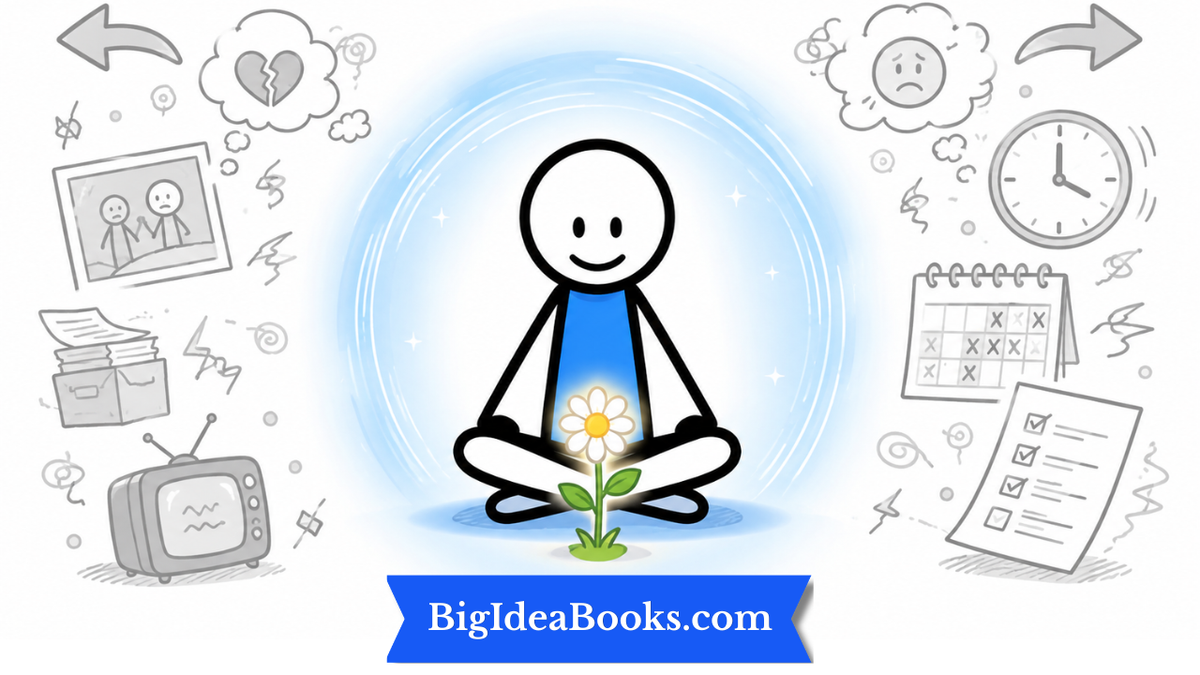
Your mind can travel almost anywhere except the place where life is actually happening. It can replay an argument from years ago, rehearse a conversation that hasn't happened yet, or turn a single difficult task into a mountain of imagined problems. Meanwhile, the present moment—the only place where you can actually respond, choose, and act—can disappear beneath all that thinking. Learning to return to the present changes not only how you experience your thoughts, but also how you relate to pain, acceptance, and action.
Focus on the Present Instead of Living in the Past or Future
The past can feel real because you can remember it vividly. The future can feel equally real because you can imagine what might happen. But neither is happening now.
Anything you actually experience happens in the present moment. A memory is something you're remembering now. A worry about next week is something you're experiencing now. When attention becomes trapped in what has already happened or what might happen, the mind can create problems that don't need to be solved in this moment.
This becomes especially useful when something feels overwhelming. Imagine facing a large project. Your mind can jump backward to the time you wasted, then forward to everything still unfinished. Suddenly, you're dealing with the entire project, yesterday's regret, and tomorrow's anxiety at the same time.
But the work itself can only be done one step at a time. You can gather one piece of information. Write one section. Make one decision. The present doesn't necessarily remove difficulty, but it reduces an enormous imagined problem to the part you can actually deal with now.
What is the main practical benefit of bringing your attention back to the present?
Observe Your Thoughts Without Automatically Following Them
Being present doesn't require you to somehow force your mind to stop producing thoughts. A more useful approach is to notice those thoughts without immediately treating them as instructions, facts, or commands.
One simple exercise is to become curious about what your mind will do next. Ask yourself what your next thought will be and pay attention. That act of observation can create a brief gap in the normal stream of thinking. For a moment, you're no longer completely absorbed in the thought process because part of your attention is watching it happen.
The same principle applies when your inner voice starts criticizing, worrying, complaining, or telling you what you should be doing. You don't have to argue with it. In fact, judging the thought can simply create another layer of thinking.
Instead, notice it. Let it exist without automatically obeying it. A thought can appear in your mind without determining what you do next. The more clearly you can observe the mind, the easier it becomes to recognize the difference between having a thought and being controlled by it.
What does it mean to observe a thought without judgment?
Stop Turning Pain Into Additional Suffering
Living in the present doesn't mean that painful things stop happening. Loss, sadness, disappointment, and hurt can still be real. Presence isn't a promise that life will become painless.
The important distinction is between experiencing pain and adding another layer of resistance to it. Something painful happens, and then the mind begins arguing with reality: This shouldn't have happened. Things have to be different. You shouldn't feel this way. The original pain is now accompanied by an internal struggle against something that has already occurred.
Acceptance doesn't require you to pretend that sadness feels good. If someone you love dies, grief is a natural response. Allowing yourself to experience that grief is very different from suppressing it or pretending everything is fine.
The shift is in allowing the reality of the moment to exist without demanding that it become something it cannot currently be. Sadness can be present without shame. Pain can be acknowledged without making resistance to that pain the center of your inner life. Presence doesn't eliminate every form of suffering, but it can prevent unavoidable pain from expanding unnecessarily.
Which response best reflects the difference between pain and additional suffering?
Accept Reality Without Becoming Passive
Acceptance can easily be misunderstood as surrender in the everyday sense: giving up, tolerating everything, or deciding that nothing should ever change. But accepting the present doesn't mean approving of every circumstance.
It means recognizing what is already true before deciding what to do about it.
If you're stuck in the mud, denying that you're stuck won't help. Panicking about how unfair it is won't free you either. You can recognize the situation exactly as it is and still start looking for a way out. Acceptance describes your relationship with the present moment; it doesn't require passivity in your behavior.
In fact, resistance can consume energy that could otherwise be used to respond. When you're not fighting the fact that something has already happened, attention becomes available for the next useful action. Instead of confronting one enormous mental problem, you can deal with individual situations as they arise.
This makes acceptance surprisingly practical. You can dislike a situation and work to change it. You can recognize a problem and take decisive action. The difference is that the action begins with seeing reality clearly rather than spending your energy insisting that the present should already be different.
What does accepting the present mean when a situation needs to change?
Try the Big Ideas
- Bring one overwhelming situation back to the present. Choose something you've been worrying about and separate the actual problem in front of you from everything your mind is adding about yesterday or tomorrow. Ask yourself what single part of the situation can be handled now, then begin there.
- Watch a thought instead of immediately following it. The next time your mind starts criticizing, worrying, or replaying something, notice the thought as if you were watching it pass by. Don't argue with it or try to make it disappear. See whether creating that small distance changes how strongly the thought controls your next action.
- Notice when pain turns into resistance. When something genuinely hurts, allow yourself to acknowledge the feeling without immediately deciding that you shouldn't feel it. Then notice whether your mind is adding another struggle by insisting that reality must already be different.
- Pair acceptance with one useful action. When you're facing a situation you want to change, state the current reality as plainly as possible without exaggerating or denying it. Once you can see what is actually happening, identify the next action available to you and take it without waiting for the situation to feel fair or comfortable.
Key Takeaways
Living in the present isn't about forgetting the past, refusing to plan, eliminating every painful emotion, or passively accepting circumstances you can change. It's about learning where your attention goes and recognizing how easily thought can pull you away from the only moment in which life and action are actually possible. When you return to the present, observe thoughts without automatically following them, allow unavoidable pain without adding unnecessary resistance, and accept reality before responding to it, difficult situations become clearer and more manageable. The larger lesson is simple: peace and effective action don't require reality to be different first; they begin with seeing the moment you're already in clearly.