$100 Million Offers by Alex Hormozi
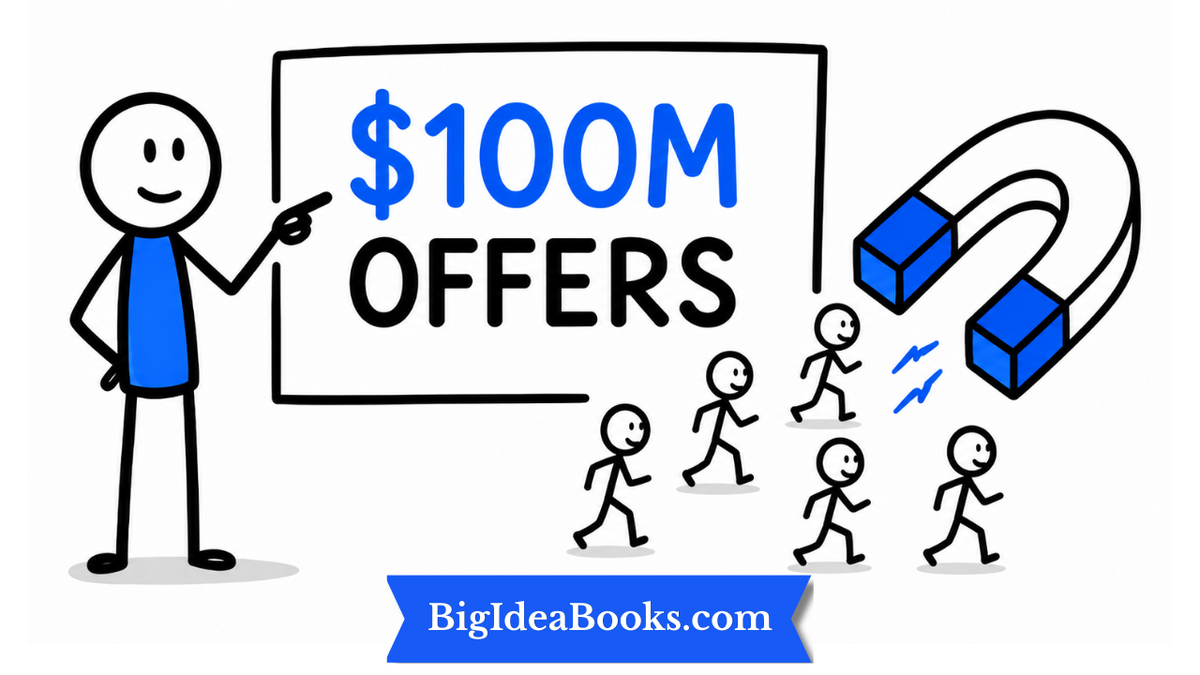
Have you ever wondered why some businesses can charge high prices and still have customers lining up? The secret is not just a good product. It's an irresistible offer. This blog post breaks down the powerful system from Alex Hormozi’s book, $100M Offers: How To Make Offers So Good People Feel Stupid Saying No. You will learn a step-by-step method to build a business that doesn't compete on price. Instead, it wins by creating so much value that saying "no" feels foolish.
This method is built on four key parts: your product, your market, your prices, and finally, your offer. By the end, you will know how to combine these parts into a money-making system.
Your Product: Never Compete on Price
Most business owners face two big problems: not enough clients and not enough profit. Many think lowering their price is the solution. They believe a cheaper product will attract more buyers. This only works for one type of product: a commodity.
A commodity is a product you can get from many places, and the quality is similar. Think of apples from different grocery stores. An apple is an apple. When selling a commodity, you must compete on price. If a customer finds a cheaper apple, they will switch stores.
This creates a bad cycle. You either lose clients or you lower your price even more to stay competitive. To win, you must avoid selling a commodity. You need a differentiated product.
A differentiated product is unique. It is not like anything else on the market. This makes it hard for customers to compare prices. They stop thinking about cost and start thinking about value.
Here is an example of a commodity service versus a differentiated one:
Commodity Service: "I offer online weight loss coaching for $1,000 down, plus $500 per month."
Differentiated Service: "I offer online weight loss coaching. You pay one time, with no monthly fee. You only pay if you see results. I guarantee you will lose five kilograms in your first month or your next month is free. You also get a personalized exercise plan, a helpful app for shopping and cooking, and 24/7 access to me for support."
Which offer would you choose? The second one is clearly better. A differentiated product forces the customer to decide between your amazing offer and nothing. Nothing else compares.
The key takeaway: Focus on creating a unique product, not a cheaper one.
Your Market: Find the Right People to Sell To
A perfect offer will fail if you sell it to the wrong people. Imagine trying to sell weight loss plans to toddlers. It won't work. You must find a market that desperately needs what you offer.
How do you find this perfect market? Look for four indicators:
- Look for Pain. Sell a solution to a current problem, not a future want. It is easier to sell a painkiller to someone with a headache than a vitamin C pill for future health. Your market must need your solution right now.
- Look for Purchasing Power. Your customers must be able to afford your price. Selling a $300 course to people who earn $300 per month will not work. Choose a market with money to spend.
- Look for Easy-to-Target People. You must be able to find your customers. Can you reach them through email lists, social media groups, or specific websites? If you can't find them, you can't sell to them.
- Look for a Growing Market. Join a market that is expanding, not shrinking. A business based on YouTube (growing) is better than one based on newspapers (dying). Three markets that always exist are health, wealth, and relationships. Find a small, growing group inside one of these big markets.
For example, consider the "relationships" market. Should you focus on college students or 60-year-old divorced men? The older group likely feels more pain from being alone. They probably have more money to spend. They are easier to find. Also, more people are turning 60 than 20, so it's a growing market. This group is a better choice.
Once you find a good market, don't sell to everyone in it. You need a niche. A niche is a small, specific segment of a market.
For example:
- Many people sell time management courses.
- Fewer people sell time management for health professionals.
- Even fewer sell time management for nurses.
- Almost no one sells time management for night shift nurses.
If you are a night shift nurse with time problems, a course made just for you feels perfect. A niche makes your product more unique. It also means you have little or no competition. Find your niche and commit to it. Do not jump from one niche to another.
Summary for finding your market:
- Choose a market with pain, purchasing power, easy targeting, and growth.
- Focus on a specific niche within that market.
- Stick with your niche.
Your Prices: Charge a Premium and Deliver Massive Value
Most people are scared to charge high prices. But to create an irresistible offer, you must. The goal is to charge so much it hurts—but only after you create tremendous value.
First, understand the difference between price and value.
- Price is what you pay.
- Value is what you get.
People buy when the value they get is greater than the price they pay. If you sell a $5,000 course, no one will buy it. But if you sell a $5,000 course that guarantees they will earn $7,000 per month within 11 months, people will listen. You changed the focus from price to value.
High prices actually help you deliver more value. Two important things happen when you raise your prices:
- You increase your client's emotional investment. If a client pays a lot of money, they are more likely to follow through. For example, in a therapy program, a client who pays more will try harder. This leads to better results.
- You can improve your business. With more money, you can hire better employees and create a better product. This improves the customer experience. Happy customers help your business grow.
So, how do you create enough value to justify a high price? Use the Four Value Drivers.
| Value Driver | What It Means | Your Goal |
|---|---|---|
| 1. Dream Outcome | The big result your customer wants. | Don't sell a gym membership. Sell weight loss, health, and confidence. Make the customer feel understood. |
| 2. Perceived Likelihood of Achievement | How certain the customer feels they will succeed. | Build so much trust that the customer is 100% sure your product will work for them. |
| 3. Time Delay | How long it takes to get the result. | Make results happen as fast as possible. People pay more for speed (like a flight vs. a bus ride). |
| 4. Effort & Sacrifice | The non-money costs (time, discomfort). | Make the process as easy and painless as possible. Reduce the hassle. |
Your main job is to increase the Dream Outcome and the Perceived Likelihood. At the same time, decrease the Time Delay and the Effort. The real gold is in reducing time and effort. Anyone can promise results. But promising faster, easier results lets you charge premium prices.
Also, look for psychological solutions, not just logical ones. A logical solution is making a faster elevator. A psychological solution is putting mirrors in the elevator so people don't notice the wait. Psychological fixes are often cheaper and more effective.
Remember: You are not just charging more. You are delivering more value. Your product must be so good that the high price still feels like a great deal for the customer.
Your Offer: The Step-by-Step Assembly Plan
Now you have a great market, a unique product, and a premium price. It's time to build the offer. This is a five-step process.
Step 1: Identify the Dream Outcome.
Ask: What does your ideal customer truly want? Make it impressive but realistic. Examples: "Make my first million dollars," or "Lose 14 kilograms in 7 weeks."
Step 2: List All Problems.
Think of every single thing someone must do to reach that dream outcome. Then, list every reason they might fail. Be detailed.
For weight loss, problems include: "Buying healthy food is hard," "I don't have time to cook," "I'm scared I'll get hurt at the gym," "I feel self-conscious exercising."
Step 3: Create a Solutions List.
For each problem, add "how to" and reverse it into a solution.
- Problem: "I'll get hurt exercising." -> Solution: "How to not get hurt while you exercise."
- Problem: "Buying healthy food is stressful." -> Solution: "How to make buying food easy and enjoyable."
Step 4: Create Solution Delivery Vehicles.
For each solution, brainstorm ways to make it happen. How could you solve this problem?
For "how to make buying food easy," you could:
- Go shopping with the client.
- Provide a personalized shopping list each week.
- Offer a "grocery buddy" system with another client.
- Create pre-made grocery carts for delivery.
Brainstorm everything, even crazy ideas. Don't rule anything out yet.
Step 5: Trim and Stack.
Now, look at the cost and value of each solution. Classify them:
- High Value / Low Cost (Perfect)
- High Value / High Cost (Maybe)
- Low Value / High Cost (Remove)
- Low Value / Low Cost (Keep as bonus)
Remove the low-value, high-cost solutions. For the high-value, high-cost ideas, ask: "Is there a simpler, cheaper version I can offer to many people?" Keep scaling it back until it's practical.
What you have left are low-cost, high-value solutions. These are often digital products like ebooks, apps, or software. They cost little to make but deliver huge value.
Building Your Final Offer Bundle:
Combine your best solutions into one package. For a weight loss offer tackling the "grocery problem," your bundle could include:
- A one-on-one nutrition orientation.
- A recorded video tour of how to shop.
- A DIY grocery calculator tool.
- Weekly personalized food lists.
- Access to a "grocery buddy" community.
- Pre-made grocery carts for delivery services.
This bundle solves just one problem (shopping) in six different ways. You would create similar bundles for cooking, exercising, and staying motivated. The final offer is a massive system that leaves almost no room for failure. The customer sees incredible value. They know the price is worth it because you have thought of everything.
Conclusion: Building a Business Beyond Competition
Creating an irresistible offer is not about tricks. It is a clear system. You start by making a product so unique that no one can compare it. You find a market of people who are in pain and can afford your help. You set a price that is high but fair for the huge value you give. Finally, you build that value by solving every single problem your customer will face.
When you follow these steps, you stop competing. You enter a category of your own. Customers are not choosing between you and a cheaper option. They are choosing between your life-changing solution and nothing.
This method takes work. It requires deep thought about your customer's problems. But the reward is a business that makes great money. You deliver real results and help people. You never have to feel bad about your prices because your offer is worth much more.
Start with one step. Define your dream customer's biggest desire. Then, begin listing what’s stopping them. Before long, you’ll be on your way to creating an offer that people feel stupid saying no to.